


Following several recent incidents, employees of RPTI International, a power systems company, have launched a strike to protest delayed salaries and missing retirement payouts.
Dozens of RPTI employees representing 300 of their colleagues yesterday called on the government to help them, as they are owed three to five months of wages, and many of those who have worked in the company for decades are worried they will not get their retirement payouts.
“I’ve been with RPTI for 14 years, and I’ve not been paid for three months already,” an RPTI employee in his 40s surnamed Chen (陳) said. “I may not have as much pressure, since I’m single, but I still have to pay for my housing loan and take care of my parents — I’ve had zero income in the past three months and have been spending my savings.”
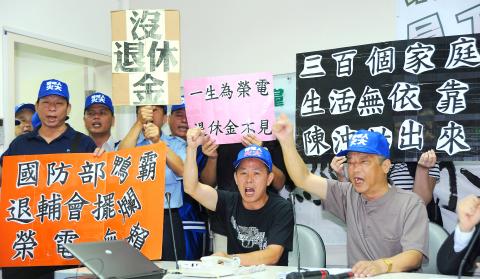
Photo: Liu Hsin-de, Taipei Times
Chen said he and his colleagues spoke with the management several times about the issue and “all they could tell us is that they don’t have sufficient money and asked us employees to work hard with the company to overcome the hardship.”
RPTI is a private corporation created by the Executive Yuan’s Veterans’ Affairs Commission (VAC) in 1975 and with most of its funding coming from state-run businesses such as Taiwan Power Co and Chunghwa Telecommunications Co. Since its founding, RPTI has been a contractor for power, electrical, mechanical and information technology facilities for many private or public construction projects.
However, RPTI is NT$4 billion (US$133 million) in debt and owes employees over NT$17 million in salaries and retirement payouts.
“The VAC and the Executive Yuan are to be held responsible for the problems, they ought to come up with solutions,” Confederation of Taipei Trade Unions chairman Chiang Wan-chin (蔣萬金) told a news conference yesterday.
“Although RPTI is officially registered as a private enterprise, its chairpersons have always been appointed by the government,” Chiang said. “The government has enjoyed all the profits, it cannot just abandon RPTI when its business is doing badly.”
The Council of Labor Affairs’ (CLA) Department of Labor Relations official Lo Chung-cheng (羅忠政) said the council recognizes the problem and understands the workers’ decision to go on strike, but that the council could not do much.
He said RPTI has a severe cash shortage and many workers have not received pay since February.
“I fully understand why they have decided to maintain the strike since last Wednesday and I respect that decision,” Lo said. “The CLA and the Taipei City Department of Labor are closely monitoring the situation and are urging RPTI to obtain the cash necessary to solve the problem. As far as we know, the company is having some difficulties in gathering money and the city’s labor department has already fined it for owing months of salaries.”
VAC secretary-general Lu Chia-kai (呂嘉凱) made similar comments on the issue.
“I have to say that it was because of your [the employees’] hard work that RPTI achieved what it did in the past, but the regrettable fact is that the company is suffering from a cash shortage,” Lu said. “The VAC is taking up its responsibility to help RPTI in its efforts to gather enough money and we’re also trying to figure out different ways to provide help.”
“Unfortunately, as a government agency, we must follow the law, and there are restrictions in law that hold us back from having some breakthroughs at the moment,” he added.
What happened to RPTI employees is not an isolated case.
In recent years, there have been numerous incidents of workers being owed salaries and retirement pensions. The company names may differ, but the storyline is more or less the same: The employer claims that the company is not in good shape, employees are told to “work with the company” to “overcome the hardship” by not receiving salaries or retirement payments, but in the end, the employer declares bankruptcy and the employees are left helpless, while authorities say that they are trying — or have tried — hard to help the workers, but there is not much they can do.
Last month, Hualon Corp workers staged a sleep-in protest in Taipei for similar reasons.
However, despite promises from government officials to help, nothing has been resolved and a strike launched by Hualon employees on June 6 is still ongoing.
Last year, workers of Auto21, a domestic auto manufacturer, went on strike for the same reason and still have not seen a solution.
“I think the core problem in such labor disputes is that the government is not determined to defend the rights of workers and the dignity enshrined in labor laws,” Taiwan Labor Front secretary-general Son Yu-lian (孫友聯) said.
“Labor disputes will always happen, but if labor laws are not reformed and worker’s rights are not seen as a priority, similar problems will continue to happen without being solved,” Son said.
He cited as an example when Jacqueline Liu (劉姍姍), former director-general of the Taipei Economic and Cultural Office in Kansas City, Missouri, was accused of underpaying her Filipino housekeepers that “she was arrested and prosecuted — but the most severe penalty for employers who violated labor laws in Taiwan is paying a fine.”
Kenneth Lin (林向愷), an economics professor at National Taiwan University, on the other hand, said the government is not giving enough help to small and medium-sized businesses, causing them to fail.
“Small and medium-sized businesses are a major economic force in Taiwan, but the government allocates more resources to large corporations rather than smaller ones,” Lin said. “Since small and medium-sized businesses actually provide more job opportunities, when they are in bad shape, workers would become victims.”
For example, he said, most textile manufacturers are declining because they do not have enough manpower to take on large orders.
“If, say, the government would allow foreign workers to take up jobs as supplementary workers when there’s not enough local manpower or when local workers are on vacation, textile manufacturers could perform better, and workers could benefit from it,” Lin said.
Lin said that while the IT industries are at their peak, “if government policies do not encourage creativity and originality, IT industries may fall in the foreseeable future just like traditional industries have today.”

UPGRADE: The Kang Ding-class frigate is replacing its Chaparall missiles with Tien Chien II and Hua Yang VLS, which would provide it with long-range, 360° air defense Taiwan plans to produce 1,200 to 1,376 Hai Chien II missiles (海劍二, Sea Sword II) — also known as TC-2N — to serve as the standard air defense system of the navy’s surface combatant fleet, a source said yesterday. Last week, the Hai Chien II, the naval version of the Tien Kung II missile (天劍二, Sky Sword II), completed a live-fire test in waters off the National Chungshan Institute of Science and Technology’s Jiupeng facility (九鵬) in Pingtung County’s Manjhou Township (滿州). The MIM72 Chaparral and other dated air defense missiles that currently arm Taiwanese ships have inadequate range to combat Chinese

REASONS FOR TRAVEL: An assistant professor said that proposed amendments to penalize drivers if they used drugs overseas would not deter people from traveling People who operate a motor vehicle under the influence of marijuana would have their driver’s license revoked, even if they used the substance while overseas, the Ministry of Transportation and Communications said yesterday, citing proposed amendments to the Road Traffic Management and Penalty Act (道路交通管理處罰條例). The amendments would also authorize the government to revoke the licenses of people determined to have used Category 1 or Category 2 narcotics, even if they were not operating a vehicle while under the influence of drugs, as well as ban them from taking the license test for three years, the ministry said. People aged 18 or

HEAVY WEATHER: Typhoon Jangmi is due to crash straight into the Ryukyus as airlines look to shift flights to larger aircraft or cancel flights to Okinawa entirely Taiwan’s international air carriers announced flight adjustments over the weekend as Typhoon Jangmi is forecast to hit the Ryukyu Islands today and tomorrow. The Central Weather Administration (CWA) upgraded Jangmi from a tropical storm to a typhoon at 8am yesterday, with the eye located 580km south of Naha city. It was moving north at 19kph. Today, China Airlines’ CI-120, CI-121, CI-122 and CI-123 flights between Taoyuan and Naha, Okinawa, have been canceled as well as CI-132 and CI-133 between Kaohsiung and Naha. EVA Air’s BR-112, BR-113, BR-186 and BR-185 flights between Taoyuan and Naha are also canceled. Low-cost carrier Tigerair Taiwan canceled IT-230,
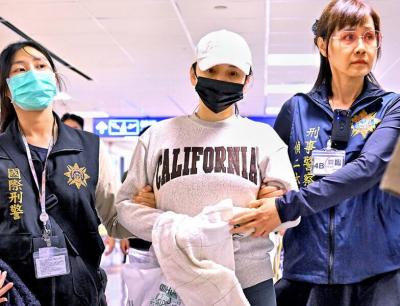
Johanne Liou (劉喬安), a Taiwanese woman who shot to unwanted fame during the Sunflower movement protests in 2014, returned to Taiwan last night after being deported from the US. She is to stand trial in Taiwan for charges involving embezzlement, fraud and drug crimes. The Criminal Investigation Bureau (CIB) said it took her into custody at Taiwan Taoyuan International Airport and would first question her before transferring her to the New Taipei District Prosecutors’ Office. She was arrested upon disembarking a flight from San Francisco that landed shortly before 7pm. Liou absconded to the US in 2019 after jumping bail


 RSS
RSS